Showing posts with label politics. Show all posts

Wednesday, March 23, 2011

Fun new multilateralism…now including al Qaida!

In a previous post, I questioned the wisdom of involving ourselves in Libya’s internal civil war.

missilejet

Now that we’ve let dozens of expensive missiles off the chain and lost one of my favorite airplanes (and shot some friendly villagers in the rescue of the pilot), I still think it’s a really bad idea.

In fact, a couple days ago, I coined the “Pulsipher Doctrine” to reduce the decision making process for involvement in military campaigns to simple mathematics. In this case, binary mathematics…

“If France and Italy are strongly in favor of the operation, don’t do it.”

       Pulsipher Doctrine, version 1

truckAs Jay Leno said last night, “Do you notice how shiny all the French planes are? It’s like they’ve never been used before!”

However, after reading press reports today of al Qaida support for the Libyan rebels, I have revised my doctrine:

“If France and Italy, or a worldwide terror network whom you are already fighting in Afghanistan, Pakistan, Iraq, Somalia, Yemen, the Philippines and many other global garden spots, are strongly in favor of the operation, don’t do it.”

      Pulsipher Doctrine, version 2

That’s right folks…this fun new multilateralism is SO expansive and open minded that we’ve found ourselves indirectly allied with our mortal enemy. That can’t be a very good sign.

Kidding aside, let me list a few of the obvious problems with our involvement in Libya:

  • NATO is not the right organization for this. NATO’s charter is to defend member states (Libya isn’t one) against aggression – this is Article 5 of the NATO charter. Article 5 is why NATO was involved in Afghanistan after 9/11 – which is the first time Article 5 was ever invoked.
  • A “No Fly Zone” doesn’t normally involve interdiction of ground operations – a.k.a. blowing up tanks.
  • We don’t know who we are supporting. The same is true in Egypt, Bahrain, Tunisia, etc. Not every conflict involves good guys and bad guys. Sometimes two bad guys fight. Is that the case here? We don’t seem interested in finding out. The British sent a team in to make contact with the rebels in early March, and the rebels captured them and sent them packing in disgrace.
  • Finally, no one in the administration, from the president on down, seems to be able to elaborate on any plan or goals. They can tell us “no ground troops – ever” and “we’re going to quit soon”, but aside from informing Gadhafi of our limits, the rationale is a mystery wrapped in an enigma. If it is about saving oppressed people, there are plenty of those around who are daily being shot at and threatened and we don’t seem as eager to engage in those places.

So after complaining about two wars in Muslim countries – including one “war of choice”, President Obama has now chosen to start a third. What’s more, the “coalition” that Obama has joined (when he wasn’t busy with his NCAA brackets) is half the size of the Bush’s “unilateral” attack on Iraq. As reported, Bush’s coalition consisted of:

Coalition Countries - Iraq - 2003

Afghanistan Albania
Australia Azerbaijan
Bulgaria Colombia
Czech Republic Denmark
El Salvador Eritrea
Estonia Ethiopia
Georgia Hungary
Italy Japan
South Korea Latvia
Lithuania Macedonia
Netherlands Nicaragua
Philippines Poland
Romania Slovakia
Spain Turkey
United Kingdom Uzbekistan

Coalition Countries – Libya – 2011

Belgium

Canada

Denmark France
Germany Greece
Italy Jordan
Morocco Norway
Poland Qatar
Spain United Arab Emirates
United Kingdom al Qaida*

*Italy and Germany were on the list, but have sort of bailed out at this point. Luckily al Qaida has been added to the Libyan coalition based on the new information reported above. And with so few members in the coalition, another participant does help pad the list.

As a side note, just let me say about the Iraq coalition, anytime you can get Ethiopia and Eritrea on the same side of anything, that’s pretty good diplomacy.

Sunday, October 24, 2010

Voting Cheat Sheet

Just as a helpful tool for all of you who haven’t voted yet, I made this handy crib sheet so you can cheat off my paper and get the correct answers…

  • Initiative 1053 – Yes
  • Initiative 1082 – Yes
  • Initiative 1098 – No
  • Initiative 1100 – Yes
  • Initiative 1105 – Yes
  • Initiative 1107 – Yes
  • Referendum 52 – Rejected
  • Resolution 8225 – Rejected
  • Resolution 4220 – Approved
  • King County Charter Amendment 1 – No
  • King County Charter Amendment 2 – Yes
  • King County Charter Amendment 3 – No
  • King County Proposition 1 – Rejected
  • US Senate – Rossi
  • US Rep Dist 8 – Reichert
  • State Rep 1 – Rodne
  • State Rep 2 – Anderson
  • State Supreme Court Justice Position 6 – Sanders
  • District Court Position 6 – O’Brien
  • District Court Position 7 – Mitchell

(ignoring the unopposed races)

Happy voting and make sure you get them in the mail ASAP. Don’t wait until November 2nd!!!

Saturday, October 23, 2010

Chemicals, Iraq, and WikiLeaks

Interestingly, the largest ever unauthorized disclosure of military documents has yielded this:

http://andrewsullivan.theatlantic.com/the_daily_dish/2010/10/chemical-weapons-were-found-in-iraq.html

And rebutting the last paragraph in that article about these chemicals not being used against US troops, we have this: http://www.intellectualconservative.com/article3448.html and this: http://www.liveleak.com/view?i=47b_1190686351

And of course, going back to this report from 2006 about post-invasion chemical finds in Iraq: http://www.foxnews.com/story/0,2933,200499,00.html

And as a little red meat, here’s an interesting American Thinker piece that asks some thought provoking questions about why Saddam played this game of high stakes WMD poker: http://www.americanthinker.com/2007/07/dont_be_so_sure_there_were_no.html

Wednesday, January 6, 2010

School Paper: Climate Change

Last term, I had to write a persuasive paper on a current topic. Given the current weather headlines…
temps

 cnn

…I thought it was worth posting here.

So without further ado, here’s “Fallacies of Anthropogenic Climate Change” for your enjoyment. (Jon Pulsipher, 12/12/2009)


Fallacies of Anthropogenic Climate Change

For the past decade at least, the conventional wisdom has been that the world is warming, that the warming represents a catastrophe in the offing, and, importantly, that this warming is directly caused by human activity – in particular, emissions of carbon dioxide (CO2) as a result of the industrial revolution. Scientists, politicians, and actors have warned that society has only a few years to save the planet and hold back the rising sea levels. But what if this conventional wisdom about climate change is all wrong? As American author and humorist Mark Twain is, ironically, quoted in Gore’s book An Inconvenient Truth, “It ain’t what you don’t know that gets you into trouble. It’s what you know for sure that just ain’t so” (2006, p20-21). While the reality of climate change is genuine, and, in fact, a continuous process, the presumption that human activity can be either the cause or the remedy is tenuous, premature, and perhaps even egotistical. The policy shifts now under consideration to control these changes would have significant, negative, and possibly irreversible impact on human progress, so they warrant careful analysis and informed decision making.

Is there climate change? The answer is a resounding, “Yes!” While the current level of media interest around climate change focuses on temperature, particularly warming trends, “climate” represents a combination of many factors. These include temperature, precipitation, cloud cover, wind, humidity and other factors. Climate generally trends cooler with increasing latitudes from the equator, but there are also micro-climates related to valleys, increases in elevation, or proximity to ocean currents. Therefore, climate, in the sense of something humans perceive and measure both globally and locally, is the result of very complex systems and interactions. Many of these are only now beginning to be understood and efforts to model the climate in a full sense are elusive (Schmitt, 2007). Consider the apparent difficulty in accurately forecasting the local weather, which uses similar models, for next week. Most people have experienced cases where the weatherman got it wrong, mere days from now. Now extrapolate that weather forecasting experience decades into the future and consider the likelihood of a successful forecast. Earth’s climatic history has indicated a general pattern of long ice ages, marked by devastating glacial advance on a massive and global scale, interspersed with warmer interglacial periods. Within these interglacial periods, there are further patterns of cooling and warming that are shorter and with less pronounced effect than a true ice age. Climatologists, geologists, and other researchers generally agree that the earth is in the middle of an interglacial period and only now recovering from the effects of the last ice age, which ended approximately 12,000 years ago. Throughout recorded human history, and pre-history, using ice cores and other investigative approaches, evidence shows that the climate has changed in significant ways many times over, as illustrated in Figure 1.

clip_image002

Figure 1 - Global temperature shifts 2500 BCE to 2040 AD (Harris & Mann 2008, ¶14)

This chart indicates that even fairly recently, the earth has been both much cooler (witness the so-called “Little Ice Age” in the late 14th to early 19th centuries) and much warmer (witness the “Medieval Warm Period,” immediately preceding the Little Ice Age) than it is today. As recently as 1991, one sees a brief but dramatic downward plunge in temperature, and, as the chart illustrates, the current warming trend does not exceed the warming seen in either the Pharaonic period in Egypt or the Medieval Warm period, and it only just exceeds the warming seen in Roman times. Interestingly, these warming periods are referred to as “climate optimums” reflecting the socio-economic benefits of a warmer climate (Horner, 2007, p. 124). Particularly for Euro-centric civilization, warming trends may seem anomalous because so much of the familiar European history and cultural events took place during the Little Ice Age period. This time of Oliver Twist, Hans Brinker, and the French Revolution – carries the positive and negative connotations of a cold climate. Want and despair, frozen canals, and desperation. The Little Ice Age was also the time when the Vikings were sent reeling back from their settlements on the previously “green” Greenland and perhaps in the Americas, due to encroaching sea ice and glaciation. In this period, it was common for the Thames River to freeze solid, and for people to travel across the Baltic Sea by sleigh, stopping overnight at taverns built on the ice (Jaworowski, 2003-2004). With this history of cold firmly ensconced in collective memory due to the explosion of literacy in this same time period, is it any wonder that a return to a warming trend can generate alarm?

In the 1970s, some climatologists, including George J. Kukla and Kenneth Hare, warned that earth was heading for an ice age, with the purported cause being that air pollution would limit the sun’s rays hitting the earth.

clip_image004

Figure 2 - The cold and ominous future imagined on the cover of Science News in the March 1, 1974 issue (Anderson & Gainor, 2006, p. 4)

In fact, as Horner recounts, media attention has alternated between the risks of catastrophic cooling and warming, generally in a cycle that trails the actual conditions at the time, as shown in table 1 (2007, p185). A notable example includes Time magazine cited experts such as Professor Nathaniel Schmidt, making the case for an ice age in 1923 only to state in 1939 that a warming trend was clearly underway (Horner, 2007, p183-184).

Warming

1981-present

Cooling

1954-1976

Warming

1929-1969

Cooling

1895-1932

Table 1 - Cycles of media focus on climate (2007, p185)

When viewed in the context of the continuous change, the notion of any kind of global “normal” temperature is tenuous. Indeed, “normal” tends to be internalized by each reader of such a statistic as relating to the bounds of their own experience – which is necessarily limited to their own lifespan. The result of this is that it seems that each summer, polls and segments on the evening news warn that this year is the hottest ever, and since it is the middle of July, one may think, “Yes, it definitely was a scorcher today,” and so the message resonates and becomes internalized. However, temperature shifts must be viewed in the context of long time spans to be understood. This is further complicated by the fact that the data reflects a long time span of activity with low resolution data points (such as ice core, fossil record and rock strata analysis, contemporary weather anecdote) for older periods spliced with high resolution information (actual temperature measurements from land and space) without clear delineation. Some climate scientists, notably Roy W. Spencer of the University of Alabama and NASA science team leader for the AQUAS temperature measuring satellite system, cast aspersions on the notion of using ice core and tree ring information as an indicator of climates long past – known as paleo-climatology – calling its practitioners “frustrated historians” rather than scientists (2008, p. 14). For many people, understanding what exactly is going on is difficult; after all, most people aren’t scientists, and even most scientists are not climate specialists.

However, just as most don’t understand the science of science, they also don’t understand the business of science. Petr Chylek, Professor of Physics and Atmospheric Science at Dahousie University in Halifax, Nova Scotia said, “Scientists who want to attract attention to themselves, who want to attract great funding to themselves, have to (find a) way to scare the public…and this you can achieve only by making things bigger and more dangerous than they really are” (Horner, 2007, p38). Dr. Chylek is by no means alone in this thinking. Climatologist Stephen Schneider, of Stanford University, said in an interview with Discover magazine in October 1989, “To capture the public imagination, we have to offer up some scary scenarios, make simplified dramatic statements and little mention of any doubts one might have. Each of us has to decide the right balance between being effective, and being honest” (Horner, 2007, p40)

Careful analysis of the data seems to indicate that the climate is currently at, or approaching, the peak of a warming cycle. There is some debate among scientists as to whether earth has, in fact, already started toward a cooling trend relative to that peak. This despite the conventional wisdom (as reflected by media reports, pop-culture, and significant numbers of political leaders around the globe) is that climate change is not only genuine, but completely, or at least significantly, the fault of human activity. The United Nations Intergovernmental Panel on Climate Change (IPCC) has aggressively forwarded the notion that climate change is largely man-caused, specifically in relation to carbon dioxide emissions as a pollutant and a so-called “greenhouse gas.” They back their conclusions with the message that there is consensus around their conclusions, meaning the science is settled; the canon is closed.

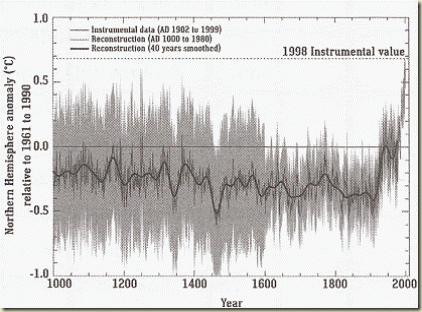
Prominent in the 2001 “IPCC Third Assessment Report” was a graph, now known as the “hockey stick,” that indicated a remarkable increase in average temperatures over the last few decades after hundreds of years of relative stability (Horner, 2007).
clip_image006

Figure 3 - 2001 IPCC "Hockey Stick" Temperature Graph

The use of this chart by the IPCC is a master-class in statistical manipulation. The grey areas of the chart indicate the margin of error for those temperatures. The method of “smoothing” the data takes advantage of the margin of error to produce a stable set of temperature readings followed by a steep climb. Note that the peak at the right side of the graph is still within the margin of error in the historic data. Also note, when comparing this graph to the generally accepted view of climate presented in figure 1, above, that the IPCC version effectively “smoothes away” both the Medieval Climate Optimum and the Little Ice Age (Horner, 2007).

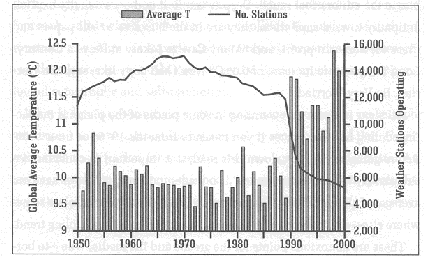
It is also noteworthy that the increase in temperature indicated on the hockey stick graph appears to be related to the closing down of a large number of weather reporting stations in the Siberian area of the former Soviet Union in the late 20th century. It stands to reason that if one stops measuring the temperature in one of the coldest regions of the earth, the overall average of the remaining measurements will increase, as indicated in figure 3 (Horner, 2007, p112). In fact, this view seems to have been validated by recent NASA satellite temperature observations, which are much more accurate and broader in coverage than earth-bound measurements (Cool it on warming, 2009). Interestingly, the same set of data also provides insight into a glaring flaw in the current climate models, clarifying the role of cloud cover as a natural response to increased temperatures (Marohasy, 2008).
clip_image008

Figure 4 - Average temperature overlaid with number of reporting stations

Whatever the specifics of the current climate change, whether the earth is experiencing abrupt and unprecedented warming, as the Climate Change lobby would suggest, or simply a continuation of normal cycles, it is reasonable to believe that most people want to be positive stewards of the earth and its resources. Recycling, carpooling, and turning off lights when leaving the room are relatively common behaviors. Clearly, these are smart and sensible measures to reduce pollution, conserve resources, and to save money. If people want to participate in such measures of their own choice, that is admirable, but they should not be under the impression that they are preventing devastating climate change. The science currently available simply does not support that. However, it is a natural to ask, “What is the harm in proceeding as if human activity was responsible for climate change?”

It has been said that “truth is the first casualty of war.” At its purest, science should be the pursuit of truth and the cornerstone of modern scientific endeavor has been peer review. In that light, consider the reply of British Climatologist Dr. Phillip Jones, the co-creator of the IPCC hockey stick graph, to Dr. Warwick Hughes when Hughes requested the opportunity to review the data behind the chart. “We have 25 or so years invested in the work. Why should I make the data available to you when your aim is to try and find something wrong with it?” (Horner, 2007, p133)

The current debate preys on the general lack of scientific literacy among the lay population to push the notion of consensus as relates to science. Consider that “consensus” is generally used in a sense relating to relationships and politics, not science. For perhaps 1500 years, the consensus was that the earth was flat. For thousands more, the consensus was that the earth was the center of the universe. As relates to climate change, the supposed consensus is not nearly as strong as the consensus was for those incorrect “facts”. As of July 2008, over 31,000 American scientists across a variety of scientific fields and including scores of members of the prestigious National Academy of Sciences, have added their names to a public petition rejecting anthropogenic climate change (31K scientists sign petition disputing global warming, 2008). In fact, Dr. Richard Lindzen, Atmospheric Physicist and MIT Professor of Meteorology, and a former member of the IPCC, states, “…I cannot stress this enough – we are not in a position to confidently attribute past climate change to carbon dioxide or to forecast what the climate will be in the future” (Lindzen, 2001, p. 32). Scientists and political figures who do not adhere to the standard “action line” on climate change call down upon their heads the ferocity of the believers, who wield epithets like “deniers” (an allusion to someone who denies that the Holocaust occurred) and even demands for lawsuits, like modern witch trials (Legates, 2003; Horner, 2007). Roy Spencer quotes a 60 Minutes reporter, when asked why opposing viewpoints were excluded from a report on global warming as saying, “If I do an interview with Elie Wiesel, am I required as a journalist to find a Holocaust denier?” (Spencer, 2008, p. 94). Dr. Spencer further noted that an Australian commentator had suggested outlawing climate change denial (ibid). Perhaps even more direct and inflammatory is the comment from David Roberts of Grist magazine:

“When we've finally gotten serious about global warming, when the impacts are really hitting us and we're in a full worldwide scramble to minimize the damage, we should have war crimes trials for these bastards -- some sort of climate Nuremberg” (Roberts, 2006, ¶3).

Other than the occasional commentator musing on the sanity of Al Gore or considering the general veracity and motivations of the climate change enthusiasts, the name calling and threats appear to be strongly one-sided.

Also representative of the highly charged nature of the debate and the appearance that there is, perhaps, a different agenda at work than saving the earth from warming, consider the words of Canadian Minister for the Environment in a meeting with the editorial board of The Calgary Herald, “No matter if the science is all phony, there are still collateral environmental benefits [to global warming policies]. Climate change [provides] the greatest chance to bring about justice and equality in the world” (Horner, 2009, p35). If the “collateral benefits” and the chance to bring about “justice and equality” are both worthwhile and correct, then scientific and political leaders in representative countries owe it to their fellow citizens to debate those matters on their merits rather than relying on inflammatory rhetoric and overblown threats of crisis.

It is ethically wrong for politicians and activists to take advantage of a lack of scientific understanding to cloak their goals in the pseudo-science of climate change rather than debating them on their own merits and winning people to their cause in an honest way. One cannot take seriously an agenda constructed on what increasingly appears to be a foundation of error, half-truth, and outright deception. Indeed the debate has moved seemingly miles away from the thinking expressed in this 1992 Democrat National Committee memo by Jonathan Sallet regarding Al Gore, “Al is a radical environmentalist who wants to change the very fabric of America. He has no sense of proportion: He equates the failure to recycle aluminum cans with the Holocaust. He believes that our civilization, itself, is evil” (Horner, 2007, p240).

Finally, many of the policies being proposed will have the direct or indirect effect of limiting human progress by placing new restrictions on agriculture and energy. Some suggest that the financial and employment benefits to be reaped by additional development in the so called “green job” economy will more than offset the lost opportunity. It would be wise to look to ongoing experiments in other countries to see this is not the case. A study of the effects of Spain’s foray into the green economy shows that every “green job” came at the cost of 2.2 traditional jobs (Alvarez, Jara, Julian & Bielsa, 2009, p. 33-36). Historically, agriculture and energy are two key tools of progress – as true in past cultures as in our own. To retreat from this means increased infant mortality, reduced life expectancy, increased hunger.

While the pesticide DDT is not related to climate change, its banning is instructive as an examination of the results of past environmental alarmism and reckless disregard for the poor. DDT was instrumental in eliminating malaria from the US and other developed nations. Based in large part on the attention garnered by Rachel Carson’s book Silent Spring, DDT was eventually banned based on what now appear to be overblown fears of threat to wildlife when used in responsible ways. While DDT has not been shown to have profound and direct impacts on human health, all chemicals carry risks and there are potential linkages between DDT exposure and hormonal issues which could result in lower sperm counts, reduced fertility, increased potential for miscarriage, etc. In contrast, the risks of malaria in terms of economic loss, death and disabling illness are profound and well-documented. When asked about the millions that have died from malaria and other diseases as a result of banning DDT, Charles Wursta, of the Environmental Defense Fund, said, “This is as good a way to get rid of them as any” (Horner, 2007, p17). Is society willing to take a step backward rather than forward? Or to willingly and cavalierly abandon the hard-fought societal gains of even a few decades? It is a safe assertion, as noted in the question to Charles Wursta, that millions of the poor in developing nations continue to die as a result of the ban of DDT.

Measures like carbon dioxide cap-and-trade and a focus on more expensive and less efficient “green” energy sources mean inevitably increased energy costs and taxes. This is not mere theory. In 2004, New Zealand was forced, by their adherence to the Kyoto accord, to purchase NZ$656 million worth of “carbon offset credits” due to increased CO2 emissions (Horner, 2007, p248). Of course the logical question would be, to whom? Clearly there are large profits to be made from these credits. Costs such as taxes and energy tend to take a proportionally larger chunk of the earnings of low income families than those of average or high income families. Like a cigarette tax, these costs disproportionately impact those least able to absorb the cost. Speaking at the 2008 International Climate Change Conference, noted economist and current Czech Republic President Vaclav Klaus said, “The dream to reduce emissions in the EU by 70 per cent in the next 30 years could only be achieved if there was a dramatic de-industrialization of Europe – likely associated with a dramatic drop in GDP, or a significant drop in population” (Marohasy, 2008).

Returning to Twain’s quote, “it’s the things we know for sure that just ain’t so” - like the pop-culture acceptance of anthropogenic climate change - that can lead to trouble. Much is said in the climate change debate concerning “scientific consensus” and “settled science.” Truly, consensus is a tool of the political realm, not the scientific one, and in true science, nothing is ever settled and beyond debate and discovery. The goals of the anthropogenic climate change movement demand dramatic steps with long term, possibly irreversible consequences. These steps will have the most profound impacts on the poor and the developing nations of the world, depriving them of the energy to more fully join the community of nations. And for all these demands, the “proof” offered appears tenuous and exposes truly the worst the aspects of the bureaucratic side of the academic science culture rather than the pursuit of truth, which most common people believe predominates. The evidence climate change based on human behaviors rather than natural cycles and, as yet, poorly understood forces, is thin. Indeed, too thin to abandon progress and economic and scientific facts in the pursuit of a utopian ideal. If utopia is the object, then utopia should be the subject of the debate. Responsible adults should be beyond the threat of pseudo-scientific boogeymen to encourage what someone might consider to be good and correct behavior. The continued progress of mankind is at stake and the decisions should not be taken lightly.


References

Alvarez, G. C., Jara, R. M., Julian, J. R. R., & Bielsa, J. I. G. (2009, March). Study of the effects on employment of public aid to renewable energy sources. Retrieved December 12, 2009, from http://www.juandemariana.org/pdf/090327-employment-public-aid-renewable.pdf

Anderson, R. W. & Gainor, D. (2006, May 17). Fire and ice. Business and Media Institute. Retrieved December 12, 2009, from http://www.businessandmedia.org/specialreports/2006/fireandice/FireandIce.pdf

Bogdan, T. (2008). The chilling stars: a new theory of climate change. Bulletin of the American Meteorological Society, 89(3), 392-393. Retrieved November 10, 2009, from Academic Search Premier database.

Cool it on warming (2009, June 7). Editorial: cool it on warming. Boston Herald (MA), Retrieved November 17, 2009, from Newspaper Source database.

Fernandez-Armesto, F. (2009). The World: A History (Vol. 1). Upper Saddle River, NJ.: Prentice Hall.

Gore, A. (2006). An Inconvenient Truth: The Planetary Emergency of Global Warming and What We Can Do About It. Emmaus, PA: Rodale.

Harris, C. & Mann, R. (2008, March 9). Global temperature trends from 2500 B.C. to 2040 A.D. Retrieved November 9, 2009, from http://www.longrangeweather.com/global_temperatures.htm.

Horner, C. (2007). The Politically Incorrect Guide to Global Warming. Washington: Regenery.

James K., G. (2004, December 16). Warming cadre waning?. Washington Times, The (DC), Retrieved November 17, 2009, from Regional Business News database.

Jaworowski, Z. (2003-2004, Winter). Solar cycles, not CO2, determine climate. 21st Century Science and Technology, 52-65.

Legates, D. (2003, August 26). Global warming smear targets. Washington Times, The (DC), Retrieved November 17, 2009, from Regional Business News database.

Lindzen, R. (2001, June 11). Scientists’ report doesn’t support the Kyoto treaty. The Wall Street Journal.

Lindzen, R. (2007, April 12). Calm down, the planet is not facing a catastrophe. Australian, The, Retrieved November 17, 2009, from Newspaper Source database.

Mark, H. (2009). Exaggerated claims risk undermining drive to cut emissions, scientists warn. Retrieved November 17, 2009, from TOPICsearch database.

Marohasy, J. (2008). New satellite data casts doubts on global warming models. Institute of Public Affairs Review, 60(2), 8. Retrieved November 17, 2009 from Academic Search Premier database.

Roberts, D. (2006, September 19). An excerpt from a new book by George Monbiot. Grist. Retrieved December 12, 2009, from http://www.grist.org/article/the-denial-industry/

Roy, S. (2005, February 17). World warms to Kyoto, but research will save the day. USA Today, Retrieved November 17, 2009, from Academic Search Premier database.

Schmitt, J. (2007, February 28). Numerical models, integrated circuits, and global warming theory. Retrieved October 30, 2009, from http://www.americanthinker.com/2007/02/ numerical_models_integrated_ci.html.

Spencer, R. (2008). Climate Confusion. New York:Encounter

Svensmark, H. (2007). Cosmoclimatology: a new theory emerges. Astronomy & Geophysics, 48(1), 1.18-1.24. doi:10.1111/j.1468-4004.2007.48118.x.

31K scientists sign petition disputing global warming. (2008, July 29). 31K scientists sign petition disputing global warming. Daily Press (Victorville, CA), Retrieved November 17, 2009, from Newspaper Source database.

Friday, November 20, 2009

School Paper: Assessing Life, Liberty, and the Pursuit of Happiness

The following is a short paper I wrote recently for a humanities class. The topic was about defining happiness and the theme of “the American Dream”. Had to wait until it was graded so the plagiarism checkers wouldn’t think I was stealing from myself. :-)


Assessing “Life, Liberty, and the Pursuit of Happiness”

clip_image002
Figure 1 - From the Declaration of Independence (Wikipedia)

The Declaration of Independence, the cornerstone founding document of the United States of America, contains the oft-quoted phrase:

“We hold these truths to be self-evident, that all men are created equal, that they are endowed by their Creator with certain unalienable Rights, that among these are Life, Liberty, and the pursuit of Happiness.” (Jefferson 1776, ¶2)

More than two centuries have passed since those eloquent words were penned, but modern immigrant Americans continue to embody the spirit and power behind these words. As an American by birth, I love my country and having spent many years living abroad, I recognize the advantages, and, in some ways, the superiority, of it compared to other systems. Yet I don’t know what it means to have chosen this country. The immigrants who continue to come to the US by the millions have chosen this country to be their own. Sometimes that means they are only here to work and take advantage of the economic climate and upward mobility. Even in troubled economic times, there are no limitations on the ability of a person to work their way from one “class” to another within our system. This stands in stark contrast to some other cultures. For example, the formal caste system of India holds down millions from reaching their potential without regard to how capable they may be. Truly, this genuine opportunity, reflected by the numbers of people who continue to “vote with their feet,” is one of the enduring achievements of the American experiment.

Examining the visible artifacts of the pursuit of happiness of the modern immigrant population, one finds that, in a 1996 analysis by the Alexis de Tocqueville Institution (Peters 1996) immigrants were the sole inventor or a collaborator on more than 26% of the patents issued between 1988 and 1994. This is all the more impressive when one considers that first generation immigrants represent less than 9% of the US population in this period. Among the inventions identified in this study are:

· A simple process for diagnosis of kidney disease invented by an Italian immigrant.

· In-home vital sign monitoring equipment invented by a Polish immigrant.

· An electrical generator cooling system invented by an Indian immigrant.

· Aeronautical controls for the space shuttle invented by a Norwegian immigrant.

These more recent contributions in science and engineering join the long list of contributions by immigrants through the history of the United States and crossing the spectrum of fields of endeavor. To name just a few, Albert Einstein - physics, John Muir – environmental awareness, Joseph Pulitzer - publishing, Charles Simonyi - software and Madeline Albright - politics (Immigration Update).

The enduring contributions of American immigrants, both recent and historic, are clearly manifest and yet too numerous to count.

There is, rightfully, much debate about legal versus illegal immigration. It is not the purpose of this paper to enter into that debate on one side or the other. Regardless of the legal status of a particular immigrant, it stands to reason quite clearly that every immigrant coming to the United States is making the de facto assertion that this country best meets at least their immediate needs in enabling their own pursuit of life, liberty, and the pursuit of happiness. That may mean they are seeking economic opportunity that social, economic, or political structures in their homeland would deny them. This can be the case even in ostensibly “free” countries – as was the case for Ian Crawford. Mr. Crawford was a native of Scotland by was “dissatisfied with the opportunities” there (Peters 1996). In other cases, their priority may be to escape oppression, such was the case for Mitchell Budniak (Peters 1996), a native Pole whose parents were escaping forced servitude in Nazi Germany during World War II. Today, you see the same familiar echoes among new immigrants arriving from China, Central America, and tumultuous African nations. They risk all for a chance to come to America, work unbelievably hard and sometimes in virtual slavery to human smugglers. And still they come just for the chance to someday control their own destiny and provide a better life for their children and their children’s children. Indeed, the American dream lives on and with it the ideals of “life, liberty and the pursuit of happiness.”

It is perhaps worthy of note that the Declaration calls out life and liberty as rights, but not happiness. It is as if the founders are telling us that while a free republic can guarantee life and liberty, the best it can do for happiness is to guarantee our freedom to pursue it; to chase that which we each define as endowing our own lives with joy.

References

Immigration Update (n.d.). Famous American immigrants. Retrieved November 8, 2009 from http://immigrationupdate.wordpress.com/famous-american-immigrants/

Jefferson, T. (1776 June). Declaration of Independence. Retrieved November 8, 2009 from http://www.archives.gov/exhibits/charters/declaration_transcript.html

Peters, P. (1996 March 6). Invented in the USA: Immigrants, Patents, and Jobs. Alexis de Tocqueville Institution. Retrieved November 8, 2009 from http://www.adti.net/imm/immpat.html

Wikipedia (2009 September 24). Thumbnail excerpt from The Declaration of Independence. Wikipedia. Retrieved November 8, 2009 from http://en.wikipedia.org/wiki/File:All_men_are_created_equal.JPG

Friday, October 9, 2009

It's official...


I awoke this morning to the bizarre news that President Obama had been awarded the Nobel Peace Prize for......."hope". Yes, that's right. So while you can't return an item for "spite", you can now receive awards for "hope".

That's right, not for anything he's done, but for the hope of what he could do. And keep in mind that the nominations closed in February, right after he was inaugurated.

In other, and arguably related news, Chicago is expecting record breaking snowfall this weekend.

That's right, ladies and gentlemen, hell seems to have frozen over.

So I guess he really did stop global warming after all.

Wednesday, September 2, 2009

Ummm…

There’s a very sad and important message in this somewhere.

schoochildren

Saturday, August 29, 2009

What I learned in the dart booth at the church picnic

And no, it isn’t about religion. It was about economics and the role of the market in moderating demand. In other words, it was about health care.

feelluckyIn our church (the Church of Jesus Christ of Latter Day Saints), we have an administrative unit called a “stake”. It is a group of congregations, kind of like a diocese in scale. Anyhoo, we have an annual picnic and usually something like 3,000 people come and there’s food and a band and stuff. This year, each congregation (called a “ward” for those playing along at home) also had to put together a little carnival type booth – face painting, old time photos, bean bag toss, etc. I was in charge of our effort (or more precisely, I was our effort, by choice, not complaining) and I put together a dart balloon popping thing. And all these booths and activities were free.

A guy in our ward (a single congregation) who is fanin the toy business had donated some pretty cool prizes. They were samples he’d had sitting around for some time I’m guessing. There were squeezy balls that looked like panda heads. (Ummm…and no, I don’t know why you’d want to squeeze a panda head.) And there were these very cool battery powered fans that lit up in the middle. His one rule about donating these prizes was “don’t bring these back to me”. Both the fact they’d been kicking around awhile and that he didn’t want them back will come into play later.

OK, so the rules of this game were simple.
1) Age 11 and under, throw from the closer line.
2) Over 11, throw from the further back line.
3) Three darts to a turn.
4) Pop a balloon, win a prize.
5) If you miss, you still get a piece of candy.

See? Simple.

I’ve played this kind of game at carnivals and amusement parks. There’s rarely a big line. The odds (for me) of winning a prize are better than most carnival games. And the itinerant serial killer carney working the booth seems to have plenty of time to blow up more balloons and put them up to replace the ones that are popped by suckers valued guests.

So here’s how it worked out for me in the nearly four hours I manned the booth…

A line quickly formed that ultimately extended about the equivalent of a block. That line stayed the entire time and, I’ll add, consisted of many of the same people. The only other booth with a line was face painting. Not even the food line was anything like this in length or duration. This was the Space Mountain of the Bellevue South Stake Picnic 2009. If you can separate Mormons from free food, and it isn’t a multi-level marketing pitch, you’re really on to something!
The lesson some of the organizers tried to take from this was, “Wow! people really like that dart game.”
NO! It wasn’t that they liked the dart game. They wanted the cool prize!
And so it began…

Issue #1
“We need to leave, do you mind if my child gets in front of the line?”
We had several of these in the time the booth was open, and people would just acquiesce and let the person go to the front. I mean, it was a church picnic after all.
But, seriously, what kind of person does this? What a wonderful life it must be to feel like your situation is soooo unique as to go ahead of 100 people waiting in the sun to try to play a free game to win a fan – that they only really think they need because they are standing in the sun trying to win one.

Issue #2
“This fan you gave me is broken! I need another one!”
Some people were nicer about this than others, but some were kind of angry about this. I mean, it was a free game, and I was happy to replace the fans, but holy crap.
As it turned out, the fans had about a 30-50% failure rate out of the box. In most cases because the batteries were dead or leaking.

Issue #3
“Our booth ran out of prizes, can we have some of yours?”
I gave them a case of 100 fans.
Then they ran into the failure rate and came back and said, “Hey, a lot of those fans don’t work. Can you give us another box?”
To which I said, basically, “WHAT? Howzbout you get your own prizes for your own #%$^@# booth?!?!” (well, not quite, but that’s what I said on the inside)
Then they started sending people with broken fans to my booth to get them replaced.

Issue #4
People showing up at the booth with three, four, or even five fans dangling from their belt.
On the one hand, I didn’t care because the mandate was to give people something to do and to get rid of these prizes, but it was an interesting experiment that, because it was free, people suddenly developed an insatiable appetite for these fans.
A side observation was seeing kids having “fan fights” where they would stick their spinning fans into each other and the fan that broke was the loser. Then the kid would get back in line and win another or just come and claim that it was broken and get another one.

Issue #5
“Hey the fan you gave my daughter got caught in her hair! YOU should be more careful about the prizes you give out to kids!”
“Dear brother in Christ, YOU should have smarter kids who, oh I don’t know, maybe don’t stick freakin’ motorized spinning things next to their head!”

The Lessons
The Role of Markets
supplydemand Markets moderate demand. When demand goes higher than can be sustained at a certain market price, the price increases to the point where demand slackens to a more sustainable level.
If each time someone played the dart game, they had to pay a dime, or donate a food item to the homeless, or use one of a rare set of tickets that were provided, or some other currency of the moment, they would weigh their “wants” much more carefully.
THIS is the thing I didn’t anticipate. I had to interrupt the flow of the line to put up more balloons, or find darts in the grass, or whatever. There was never a slack moment in demand.
At the end of the day, I still had a bunch of these fans and I just started giving them away to the people waiting in line and some people would reach in the box and take three or four of them and then ask if I had more.
Demand for the least worthwhile of goods becomes insatiable when the price is zero.

Rationing
I noticed that one of the booths, started putting a dot on kids hands when they did their activity and not allowing repeats. I think it was the cotton candy booth. One kid was sad because they had dropped whatever it was and then couldn’t get more of it. Not that kids need more cotton candy or popcorn or what-have-you, but the only way to limit demand is a strict ration and that can be unrelenting and harsh in the face of genuine need. (or perceived need)
I didn’t do this, although I though of it, because, again, I wanted to get rid of the fans. 
In a market driven economy, the market forces do the rationing by allowing people to choose what is most important to them.
In a centrally planned economy, these choices tend to disappear either by direct government action or through the reactions of market forces to indirect government intervention into that market.

Entitlement
It was genuinely surprising how a control group of unusually nice people at a church picnic could quickly feel entitled to these prizes. “Hey, my dart bounced off that balloon! Is this rigged?” (Yes, sir, I’ve rigged this free game of skill and chance so I can get money, power, jollies?)
Not too mention those people in the neighboring booth who seemed determined to have equal access to the prizes I’d arranged for MY booth.
And when the event was over and the organizers told me I needed to shut down, I still had people coming up wanting prizes while I was cleaning up and being clearly disappointed that they were gone – while they had two or three fans in their hands right before me.

So to end my sermon, brothers and sisters, I’ve spent an afternoon in ObamaCare, and it looks a lot like a dart game booth at a church picnic.
Only we won’t be clamoring for our fifth lame light up fan. We’ll be begging for our first necessary appendectomy while our doctor consults the bureaucracy to see if we should just maybe take the pain pills instead.
Be afraid! Be very afraid!

And, by the way, keep up the fight, we’re winning. Thanks to folks like David Hedrick. Semper Fi Cpl Hendrick. (As we all know, there are no “former” Marines, no matter what Sean Hannity says <g>)

And, all kidding aside, I can’t end this without a big shout out to the H’s, the C’s, and the T’s for all the help blowing up balloons. To P for the prizes. And to my family for their patience while we got through this lame assignment. :-)

Thursday, July 30, 2009

Three men and a Biden

The AP story on Obama having Sgt Crowley and Professor Gates over for a beer and peer mediation session contained this portion that just struck me as pretty funny. (I’m including a screenshot of the story in case they change it later.)

story

That put me in mind of this great Hollywood production…

threemenandabiden2

(Barack has just learned that NO ONE messes with Joe!)

Wednesday, July 29, 2009

Soldier Demands Apology for Obama-Care

Continuing on the healthcare motif…you’ve got to love this video of a soldier schooling Clair McCaskill on the meaning of her duty to the Constitution – courtesy of RealClearPolitics.

Of course, Ms. McCaskill wasn’t actually at this town hall to my knowledge, but a brilliant statement nonetheless.

Monday, July 27, 2009

…and among these are life, liberty, and insurance…

Sorry I haven’t posted for quite a while. Work and summer time fun have been taking an unfair share of my time.

declaration I was thinking about insurance. In an effort to identify common ground, I think any rational person would have to admit that it is unfair that an insurance company can charge exorbitant rates based on pre-existing conditions, charge different rates based on lifestyle choices, age, where you live, and even gender – if you can believe that still goes on in the 21st century.
Then, heaven forbid you need to make a claim. Then you’ll have to deal with sky-high deductibles and confront an insurance agency that wants to steer you to their preferred network of providers.
And the more you need them, the more likely they are to jack up their rates or drop you entirely.

Maybe insurance really is a basic right. Maybe there should be a publicly funded option.

You’ve heard all this before, I know. But in my case, I’m talking about car insurance.
That’s right. Remember what it was like to buy insurance as a young, unmarried male? And if you have had an accident in the past you may need to sell a couple vital organs when the bill comes due.

Seen from the point of view of the insurance company though, they’ve got years of data that backs up the fact that a young man  driving a Nissan 350zx or a Mustang is more likely to get in anMUSTANG_HIGH accident than a 40 year old married woman driving a Honda Odyssey. And they have equal stacks of data that tell them that it costs more to fix a door ding on a Bentley than a smashed up Celica.

And if you don’t like their service, you can move from Progressive to Geico (as we did some years ago). If you want a local agent that covers all your insurance needs, feel free to pick State Farm.

I hope to most people, the idea of national car insurance seems ridiculous. But, really, is it any more ridiculous than national health insurance?
Some would say that medical care is a basic human right. After all, the Declaration of Independence says “life” is an inalienable right. But it says the same about “the pursuit of happiness”. Despite decades of light-rail dreaming from social engineers and city planners, a car is the gateway drug to the pursuit of happiness in America.

Most people value the fact that we can pick a company, coverage, deductibles and payment terms that suit our car insurance needs. Why would we accept less from our medical insurance choices?
Some of you may remember when you could buy a so called “major medical” insurance policy. That is, a policy with a high deductible and affordable rates that was really intended to kick in to cover very significant medical bills. This was a great choice for young people who were generally healthy but wanted a degree of insurance protection. In most states, this type of policy has gone by the wayside as states have placed heavy requirements on insurers.
For example, here are the Mandated Benefits as dictated by Washington State and Federal Law. Note that mammograms are covered, as is chiropractic care and prenatal screening. I’m sure this is a great comfort to any young single man who thinks chiropractors are nuts. And yet, there is no provision (as near as I can tell) for changing benefits or rates based on gender or other such factors.

We don’t need more government intervention in health care.
What we need is more choice and more market forces. And the ability to charge rates corresponding to the projected consumption of services. If choice is good enough for your car, isn’t it good enough for your health?

geicocaveman01
Liberty…so easy a caveman could do it. (and another of those inalienable rights, by the way)

Some resources for the health care debate:

Thursday, April 16, 2009

Reflections on Tea Parties

I’ve heard so much nonsense written about these tea parties. Let’s leave MSNBC’s homo-erotica totally out of the picture and just talk about reasonably reputable sources.

CNN says they are “anti-CNN”. Wow! Narcissist much? These are the kind of guys that Tweet, “I’m eating a really good sandwich right now” without realizing that even their friends don’t care.
This is the ranting of a network that has no idea how irrelevant they are in their own marketplace. <cough cough> ratings <cough>

Fox News says they are “anti-Tax” (same page, scroll down a little). Well, at least they aren’t saying they are “pro Fox”. They are a little anti-Tax, but not in the sense that we don’t think we should pay taxes.
In fact, I think 9 out of 10 party goers would agree that MORE people need to be paying taxes. A fundamental problem with our system now is that only about half the people pay anything at all and the top 2-3% of income earners pay the lion’s share. Everyone should be a stake holder in America. No one group should get a tax cut or tax increase. That is the epitome of fairness and avoids the
built-in danger of all democracies.
Somehow Fox News has seized for itself some sort of credit in this movement. I’m not sure how that happened. We all know that this idea is straight from
Rick Santelli on CNBC.

Republican party leaders seem to think this is an event supporting them. Hold on there guys. Please reference the Congressional Record from 2001-2006 and tell me why we’d be looking to you for leadership. I heard of some tea party events where Republican politicians were booed off the stage.

People everywhere are saying they are “anti-Obama”. I’ll concede there is a heavy thread of this but ONLY because he’s the current driver of this policy. Virtually all of the people at these tea parties were just as upset at the Bush-Paulson plan, which Obama has extended and continued. Virtually all of the people at these tea parties were just as upset at the Bush stimulus plan of 2008, and it was a mere shadow of the current one.
And Obama’s not alone. Pelosi and Reid are right up there on the anger list.

The key to “getting it” on these tea parties is to realize that what people are upset about are fundamental changes to the fabric of our culture and society that will have a starkly negative outcome. This isn’t a guess. You can look at many examples, the UK comes to mind. As Margaret Thatcher said, “The problem with socialism is that eventually you run out of other people’s money.”

So the tea parties are not about throwing Obama out. They're not about cutting taxes per se. They are about stopping our trip down this change in our economic system. Consider:

There are two choices facing us: “trickle down prosperity” (AKA the way economies actually work, like it or not) or “trickle up poverty”.
We newly dubbed right wing extremist tea party goers prefer the former.

You can point fingers all you want, but the entire mess we are in right now has its roots in government intervention in the housing market that forced institutions to loan money to people who shouldn’t have gotten loans. In response to that level of risk, these same institutions created all kinds of securitization to protect themselves from that injection of business risk.
Further, the government institutions Fannie and Freddie have been piggy banks for politicians (
primarily Democrat ones) and pretended to be both private and public institutions depending on what suited them in a particular instance.

Capitalism and free markets didn’t fail. The thumb of government was on the scale the whole time and markets were trying to react and protect themselves as best they could until it all came down.

There are solutions for all this. “Bankruptcy” (sorting good assets from bad ones and getting the value from the good), “foreclosure” (removing you from property you don’t own and aren’t keeping your word in paying for), and “renting” (the place you live when you can’t afford a house). Just let it happen and it will all get better a lot more quickly.

Extremist chatter: A report from the Tea Parties

As a new member of the Homeland Security watchlist, I went to two Tea Party events yesterday. One in Bellevue at lunch time and one in Seattle in the evening.
Thanks for the idea Rick Santelli.

Bellevue
Bellevue Crowd 1 Bellevue Crowd 2
The Bellevue event was on the lawn at City Hall and was really well attended for a mid-day event. Using the technique of counting a section of the crowd and then multiplying that across the area, I came up with about 1200 people. There were some empty pockets here and there though, so let’s call it about a thousand. I’ve not seen an estimate of the attendance in any of the press reports.

In general, I’m really opposed to Republican politicians glomming onto these events. Let’s not forget that they spent like drunken sailors while in power and that the first round of bailouts was a product of the Bush administration. (And, as someone at the event said, at least the drunken sailor is spending HIS OWN money.)
However, a Bellevue City Councilman, Conrad Lee, spoke. Mr. Lee is an immigrant (a legal one, thank you Mr. Lee) who came to the US 15 years ago. He said that at the time he was just looking for economic freedom and opportunity. He found that but he found something more that he hadn’t expected in the political freedom and the opportunity to make a difference. It was a great story and I love hearing from first generation (legal) immigrants.
Another speaker was Toby Nixon. Toby is also a Microsoft employee and happens to be an LDS guy. He is a former state legislator and now the head of a policy group. In his talk, he said, “There are four boxes that protect our freedom. The soap box. The ballot box. The jury box. And the ammo box. Preferably in that order.” (insert wild applause and hoo-uhs) He elaborated on each of the first three and one of the things I appreciated was his call to stop trying to get out of jury duty. I’ve never been sure why people do that. Do we want juries left in the hands of complete morons?

My hastily made sign read “Pay your own #!?@~$">#!?@~$ mortgage!” on one side and “Dude, where’s my country?” on the other.

I had to leave a little early to get back to work for a 1pm feature review meeting. Good time though.

Seattle
This was a family affair for us (except our oldest who is at college). We got to the event a little late. I was puzzled why the woman MC’ing was dressed as Alice (from Alice in Wonderland). As I write this, I’m just remembering the tea party scene, so I suppose it makes some kind of sense.
There were more people at the Seattle event, but still less than two thousand. I haven’t seen any estimates, but it was much more organized in the sense that they had sign up lists to stay involved going forward and “official” people in little yellow hard hats who were moving through the crowd doing various “official” things.
And it was in Seattle, so there were a few nuts. There was one anti-Walmart guy and one guy who was either for or against bioengineering, but we couldn’t really tell. He was dressed in a black facemask and goggles and had a cape made from a UW Huskies flag. <head scratching> Not sure what was up with that. Seattle Crowd

The worst part is there were a couple of people with really offensive signs. One depicted a Barak Obama figure with strings going up to a Star of David and a stereotypical “evil Jew” controlling him. That doesn’t even make any sense. I don’t think Obama has shown himself to be even a friend of Israel. In addition to being anti-Semitic and evil, it just doesn’t make any sense at all.
The other sign was a single “counter-protestor” with a reference to sexual activity that is the current way of talking about the Tea Parties on MSNBC. I would wager that more people saw this guy’s stupid sign at the Tea Party than were watching MSNBC in that same 2 hour timeslot nationwide.

Anyway, great energy in the crowd and a fun family event. Here we are being escorted away by the horse mounted riot police.*
Riot cops? Really?

* OK, not really, we just happened to be walking in front of them on the way to the car, but seemed funny they were there.

I think daughter #2 was hoping for some window smashing and car burning and may have felt a little disappointed when we all dispersed peacefully at the end.

So how about you? How’d you spend your April 15th?

Tuesday, February 24, 2009

Tuesday, February 10, 2009

It takes a federal government to raise a parking lot

Fresh on the heels of the senate's passage of their version of the "stimulus" plan comes this delightful piece at Newsbusters.org.
When Laura Ingraham pressed RINO Arlen Spector (R?-PA) on the job creating ability of the package, he included this little gem:

"And I talked to the mayor of a major city this morning that has a parking plot
going up, which is out of money and the work can go forward this afternoon."

There you have it folks. This is the kind of project that municipalities, states, and the private sector just can't handle alone. This is the kind of project that we can look toward to get Americans back to work. Building parking lots.

Nice one.

Now, you might say, "Hey, I know unemployed construction workers. Maybe this isn't so bad."
Aha! But remember that Robert Reich said at the Economic Recovery Plan Meeting in January:

"if construction jobs go mainly to white males who already dominate the
construction trades, many people who need jobs the most -- women, minorities,
and the poor and long-term unemployed -- will be shut out."

So we not only want to build a grand federal ediface of a parking garage, but we want to build it NOT with people who already know what they are doing, who already "dominate the construction trades", but with people who are not employed in the construction field today.

Honestly, I'd prefer to park my car in a building constructed by the people who "dominate the construction trades."

Lest anyone take the wrong emphasis from this, I'm scoffing at the idea of non-construction workers being first in line for construction jobs - regardless of race or whatever.

Hey, I've never dominated the brain surgery field. Will this stimulus plan make me first in line for a job in that trade?

Friday, January 9, 2009

Why doesn't economic stimulus work?

"If people would say to me, 'Would you rather recover or be stimulated?' I think I'd rather be stimulated." - Rep. Barney Frank, Department of the Treasury Office of Thrift Supervision National Housing, December 8, 2008.

I've been thinking on this for a long time. Stimulating the economy in rough times clearly used to work. It worked somewhat in the Depression (although the tax cuts were quickly erased when Hoover tripled the tax rate to 63% in 1932) and it worked in the Reagan era, particularly in the 1982 recession. G.W. Bush has tried both direct checks and tax cuts and, with the exception on the cut in the tax on dividends and capital gains, they haven't done much. Let's look at this a little more.

Economist John Maynard Keynes proposed his approach to stimulating the economy by increasing demand through the injection of money at the "bottom". (called "Keynesian Economics" or "Keynesian Theory", in case you want to look smart at your next block party)

It seems that every politician of every stripe the world over accepts this theory, without paying much attention to the fact that it seems not to work. For people ambivalent to government spending at least, it seems like a sound idea. Why doesn't it work?

Here's my primary theory, and I'll follow that up with an alternate theory. Just in case.

In a factory economy, things were produced and consumed within the borders of a nation. Stimulating demand would give people money to buy those products, which translates into increased orders at the factories that provided employment.

In a post-industrial economy, where global tranportation systems and multinational trade agreements, more and more consumer products are imported. This means some of that stimulus money goes to "locals" - the guy at the TV store, the guy at the car dealership, etc.

This is a natural evolution of economies. I'm not arguing that we need to preserve the factory economy of old. But it does seem to indicate that pumping money into people's hands is just not going to have the intended effect. It simply create a double-speed money pump to move US wealth overseas. (by both selling bonds to get the money for the stimulus and from the money leaving the country)

Alternate theory
Most Americans live live's full of debt. You have people rolling in car loans and credit card debt into their mortgage refi - which means they are paying for the Taco Bell lunch from a couple months ago for 30 years! Insanity. So if they get a few extra dollars, they pay a bill with it. Paying old bills is better than NOT paying them, but it won't stimulate the economy. The extra money simply vaporizes immediately.

Tuesday, January 6, 2009

Discussion topic #1


"The United States has moved faster towards socialism in the past 90 days than in the previous 30 years." - David Keene, Interviewed in December 2008. Sorry, couldn't find an online source for this interview, but I have the paper copy.

Agree? Disagree?

Is it a good or bad thing? Does it even matter?

I found this article by Dick Morris (who I find an odious individual) about Bush introducing European Socialism to the US as his final "contribution". It's pretty good and sums up my feelings pretty well. I can't imagine what the left would have against Bush; he's given them their fondest dream.

Thursday, January 1, 2009

The Forgotten Man

I think one of the foremost problems in our country is the level of indifference and ignorance to history. When you don't understand history, every change in the wind can look like an unprecedented crisis.

Since "they got this depression on", I'm reading The Forgotten Man: A New History of the Great Depression by Amity Shlaes.
The title comes from an 1883 essay of the same title by Yale professor and sociologist William Graham Sumner. Quoting:


"The type and formula of most schemes of philanthropy or humanitarianism is this:
A and B put their heads together to decide what C shall be made to do for D. The radical vice of all these schemes, from a sociological point of view, is that C is not allowed a voice in the matter, and his position, character, and interests, as well as the ultimate effects on society through C's interests, are entirely overlooked. I call C the Forgotten Man."


In other words, when things look bad for somebody, you can count on two other people getting together to solve it and stick someone else with the bill.

The book was originally published in 2007 and predating the sudden "crisis" of 2008 so there is no taint of foreknowledge. So it is amazing at the similarities not just in the events, but also in the political situation and the personalities of the people involved.

In particular, the comparisons between Hoover and Bush are very interesting. Both brought "firsts" to the presidency. Hoover was the first trained engineer and Bush the first MBA - which means both were men of their times. Both men carried ideologies that were heavily colored by deeply held religious beliefs. And both were Republicans who did not hold to Conservative principles.


I'll be sharing more on this book over the next several posts, but it in the meantime, consider that it is interesting that Ben Bernake, who, along with Henry Paulson, is in charge of central planning for the US economy right now, said in his remarks on Milton Friedman's 90th birthday regarding the Federal Reserve's role in making an ordinary recession in the late 20's into the Great Depression: "You're right. We did it. We're very sorry." Ummmm......

Ready... Fire... Aim...
We should all be a lot less worried about the US economy weathering down cycles than I am about the government stepping in to try to "fix" it.

I think it is curious that the financial crisis suddenly erupted six weeks before the Nov 2008 election and then it was necessary for a bunch of politicians to "solve" a complex situation years in the making over a long weekend with little to no input from actual economists - who clearly opposed it - saying basically - "We're not sure what the right answer is, but this is definitely NOT it."