Last term, I had to write a persuasive paper on a current topic. Given the current weather headlines…


…I thought it was worth posting here.
So without further ado, here’s “Fallacies of Anthropogenic Climate Change” for your enjoyment. (Jon Pulsipher, 12/12/2009)
Fallacies of Anthropogenic Climate Change
For the past decade at least, the conventional wisdom has been that the world is warming, that the warming represents a catastrophe in the offing, and, importantly, that this warming is directly caused by human activity – in particular, emissions of carbon dioxide (CO2) as a result of the industrial revolution. Scientists, politicians, and actors have warned that society has only a few years to save the planet and hold back the rising sea levels. But what if this conventional wisdom about climate change is all wrong? As American author and humorist Mark Twain is, ironically, quoted in Gore’s book An Inconvenient Truth, “It ain’t what you don’t know that gets you into trouble. It’s what you know for sure that just ain’t so” (2006, p20-21). While the reality of climate change is genuine, and, in fact, a continuous process, the presumption that human activity can be either the cause or the remedy is tenuous, premature, and perhaps even egotistical. The policy shifts now under consideration to control these changes would have significant, negative, and possibly irreversible impact on human progress, so they warrant careful analysis and informed decision making.
Is there climate change? The answer is a resounding, “Yes!” While the current level of media interest around climate change focuses on temperature, particularly warming trends, “climate” represents a combination of many factors. These include temperature, precipitation, cloud cover, wind, humidity and other factors. Climate generally trends cooler with increasing latitudes from the equator, but there are also micro-climates related to valleys, increases in elevation, or proximity to ocean currents. Therefore, climate, in the sense of something humans perceive and measure both globally and locally, is the result of very complex systems and interactions. Many of these are only now beginning to be understood and efforts to model the climate in a full sense are elusive (Schmitt, 2007). Consider the apparent difficulty in accurately forecasting the local weather, which uses similar models, for next week. Most people have experienced cases where the weatherman got it wrong, mere days from now. Now extrapolate that weather forecasting experience decades into the future and consider the likelihood of a successful forecast. Earth’s climatic history has indicated a general pattern of long ice ages, marked by devastating glacial advance on a massive and global scale, interspersed with warmer interglacial periods. Within these interglacial periods, there are further patterns of cooling and warming that are shorter and with less pronounced effect than a true ice age. Climatologists, geologists, and other researchers generally agree that the earth is in the middle of an interglacial period and only now recovering from the effects of the last ice age, which ended approximately 12,000 years ago. Throughout recorded human history, and pre-history, using ice cores and other investigative approaches, evidence shows that the climate has changed in significant ways many times over, as illustrated in Figure 1.

Figure 1 - Global temperature shifts 2500 BCE to 2040 AD (Harris & Mann 2008, ¶14)
This chart indicates that even fairly recently, the earth has been both much cooler (witness the so-called “Little Ice Age” in the late 14th to early 19th centuries) and much warmer (witness the “Medieval Warm Period,” immediately preceding the Little Ice Age) than it is today. As recently as 1991, one sees a brief but dramatic downward plunge in temperature, and, as the chart illustrates, the current warming trend does not exceed the warming seen in either the Pharaonic period in Egypt or the Medieval Warm period, and it only just exceeds the warming seen in Roman times. Interestingly, these warming periods are referred to as “climate optimums” reflecting the socio-economic benefits of a warmer climate (Horner, 2007, p. 124). Particularly for Euro-centric civilization, warming trends may seem anomalous because so much of the familiar European history and cultural events took place during the Little Ice Age period. This time of Oliver Twist, Hans Brinker, and the French Revolution – carries the positive and negative connotations of a cold climate. Want and despair, frozen canals, and desperation. The Little Ice Age was also the time when the Vikings were sent reeling back from their settlements on the previously “green” Greenland and perhaps in the Americas, due to encroaching sea ice and glaciation. In this period, it was common for the Thames River to freeze solid, and for people to travel across the Baltic Sea by sleigh, stopping overnight at taverns built on the ice (Jaworowski, 2003-2004). With this history of cold firmly ensconced in collective memory due to the explosion of literacy in this same time period, is it any wonder that a return to a warming trend can generate alarm?
In the 1970s, some climatologists, including George J. Kukla and Kenneth Hare, warned that earth was heading for an ice age, with the purported cause being that air pollution would limit the sun’s rays hitting the earth.

Figure 2 - The cold and ominous future imagined on the cover of Science News in the March 1, 1974 issue (Anderson & Gainor, 2006, p. 4)
In fact, as Horner recounts, media attention has alternated between the risks of catastrophic cooling and warming, generally in a cycle that trails the actual conditions at the time, as shown in table 1 (2007, p185). A notable example includes Time magazine cited experts such as Professor Nathaniel Schmidt, making the case for an ice age in 1923 only to state in 1939 that a warming trend was clearly underway (Horner, 2007, p183-184).
| Warming | 1981-present |
| Cooling | 1954-1976 |
| Warming | 1929-1969 |
| Cooling | 1895-1932 |
Table 1 - Cycles of media focus on climate (2007, p185)
When viewed in the context of the continuous change, the notion of any kind of global “normal” temperature is tenuous. Indeed, “normal” tends to be internalized by each reader of such a statistic as relating to the bounds of their own experience – which is necessarily limited to their own lifespan. The result of this is that it seems that each summer, polls and segments on the evening news warn that this year is the hottest ever, and since it is the middle of July, one may think, “Yes, it definitely was a scorcher today,” and so the message resonates and becomes internalized. However, temperature shifts must be viewed in the context of long time spans to be understood. This is further complicated by the fact that the data reflects a long time span of activity with low resolution data points (such as ice core, fossil record and rock strata analysis, contemporary weather anecdote) for older periods spliced with high resolution information (actual temperature measurements from land and space) without clear delineation. Some climate scientists, notably Roy W. Spencer of the University of Alabama and NASA science team leader for the AQUAS temperature measuring satellite system, cast aspersions on the notion of using ice core and tree ring information as an indicator of climates long past – known as paleo-climatology – calling its practitioners “frustrated historians” rather than scientists (2008, p. 14). For many people, understanding what exactly is going on is difficult; after all, most people aren’t scientists, and even most scientists are not climate specialists.
However, just as most don’t understand the science of science, they also don’t understand the business of science. Petr Chylek, Professor of Physics and Atmospheric Science at Dahousie University in Halifax, Nova Scotia said, “Scientists who want to attract attention to themselves, who want to attract great funding to themselves, have to (find a) way to scare the public…and this you can achieve only by making things bigger and more dangerous than they really are” (Horner, 2007, p38). Dr. Chylek is by no means alone in this thinking. Climatologist Stephen Schneider, of Stanford University, said in an interview with Discover magazine in October 1989, “To capture the public imagination, we have to offer up some scary scenarios, make simplified dramatic statements and little mention of any doubts one might have. Each of us has to decide the right balance between being effective, and being honest” (Horner, 2007, p40)
Careful analysis of the data seems to indicate that the climate is currently at, or approaching, the peak of a warming cycle. There is some debate among scientists as to whether earth has, in fact, already started toward a cooling trend relative to that peak. This despite the conventional wisdom (as reflected by media reports, pop-culture, and significant numbers of political leaders around the globe) is that climate change is not only genuine, but completely, or at least significantly, the fault of human activity. The United Nations Intergovernmental Panel on Climate Change (IPCC) has aggressively forwarded the notion that climate change is largely man-caused, specifically in relation to carbon dioxide emissions as a pollutant and a so-called “greenhouse gas.” They back their conclusions with the message that there is consensus around their conclusions, meaning the science is settled; the canon is closed.
Prominent in the 2001 “IPCC Third Assessment Report” was a graph, now known as the “hockey stick,” that indicated a remarkable increase in average temperatures over the last few decades after hundreds of years of relative stability (Horner, 2007).
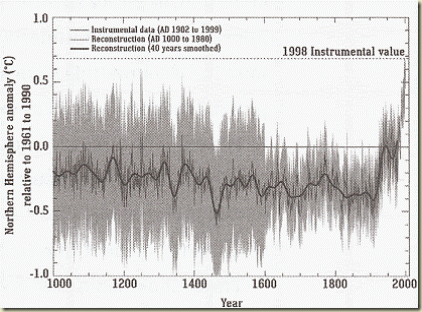
Figure 3 - 2001 IPCC "Hockey Stick" Temperature Graph
The use of this chart by the IPCC is a master-class in statistical manipulation. The grey areas of the chart indicate the margin of error for those temperatures. The method of “smoothing” the data takes advantage of the margin of error to produce a stable set of temperature readings followed by a steep climb. Note that the peak at the right side of the graph is still within the margin of error in the historic data. Also note, when comparing this graph to the generally accepted view of climate presented in figure 1, above, that the IPCC version effectively “smoothes away” both the Medieval Climate Optimum and the Little Ice Age (Horner, 2007).
It is also noteworthy that the increase in temperature indicated on the hockey stick graph appears to be related to the closing down of a large number of weather reporting stations in the Siberian area of the former Soviet Union in the late 20th century. It stands to reason that if one stops measuring the temperature in one of the coldest regions of the earth, the overall average of the remaining measurements will increase, as indicated in figure 3 (Horner, 2007, p112). In fact, this view seems to have been validated by recent NASA satellite temperature observations, which are much more accurate and broader in coverage than earth-bound measurements (Cool it on warming, 2009). Interestingly, the same set of data also provides insight into a glaring flaw in the current climate models, clarifying the role of cloud cover as a natural response to increased temperatures (Marohasy, 2008).
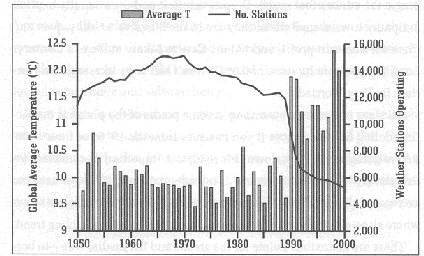
Figure 4 - Average temperature overlaid with number of reporting stations
Whatever the specifics of the current climate change, whether the earth is experiencing abrupt and unprecedented warming, as the Climate Change lobby would suggest, or simply a continuation of normal cycles, it is reasonable to believe that most people want to be positive stewards of the earth and its resources. Recycling, carpooling, and turning off lights when leaving the room are relatively common behaviors. Clearly, these are smart and sensible measures to reduce pollution, conserve resources, and to save money. If people want to participate in such measures of their own choice, that is admirable, but they should not be under the impression that they are preventing devastating climate change. The science currently available simply does not support that. However, it is a natural to ask, “What is the harm in proceeding as if human activity was responsible for climate change?”
It has been said that “truth is the first casualty of war.” At its purest, science should be the pursuit of truth and the cornerstone of modern scientific endeavor has been peer review. In that light, consider the reply of British Climatologist Dr. Phillip Jones, the co-creator of the IPCC hockey stick graph, to Dr. Warwick Hughes when Hughes requested the opportunity to review the data behind the chart. “We have 25 or so years invested in the work. Why should I make the data available to you when your aim is to try and find something wrong with it?” (Horner, 2007, p133)
The current debate preys on the general lack of scientific literacy among the lay population to push the notion of consensus as relates to science. Consider that “consensus” is generally used in a sense relating to relationships and politics, not science. For perhaps 1500 years, the consensus was that the earth was flat. For thousands more, the consensus was that the earth was the center of the universe. As relates to climate change, the supposed consensus is not nearly as strong as the consensus was for those incorrect “facts”. As of July 2008, over 31,000 American scientists across a variety of scientific fields and including scores of members of the prestigious National Academy of Sciences, have added their names to a public petition rejecting anthropogenic climate change (31K scientists sign petition disputing global warming, 2008). In fact, Dr. Richard Lindzen, Atmospheric Physicist and MIT Professor of Meteorology, and a former member of the IPCC, states, “…I cannot stress this enough – we are not in a position to confidently attribute past climate change to carbon dioxide or to forecast what the climate will be in the future” (Lindzen, 2001, p. 32). Scientists and political figures who do not adhere to the standard “action line” on climate change call down upon their heads the ferocity of the believers, who wield epithets like “deniers” (an allusion to someone who denies that the Holocaust occurred) and even demands for lawsuits, like modern witch trials (Legates, 2003; Horner, 2007). Roy Spencer quotes a 60 Minutes reporter, when asked why opposing viewpoints were excluded from a report on global warming as saying, “If I do an interview with Elie Wiesel, am I required as a journalist to find a Holocaust denier?” (Spencer, 2008, p. 94). Dr. Spencer further noted that an Australian commentator had suggested outlawing climate change denial (ibid). Perhaps even more direct and inflammatory is the comment from David Roberts of Grist magazine:
“When we've finally gotten serious about global warming, when the impacts are really hitting us and we're in a full worldwide scramble to minimize the damage, we should have war crimes trials for these bastards -- some sort of climate Nuremberg” (Roberts, 2006, ¶3).
Other than the occasional commentator musing on the sanity of Al Gore or considering the general veracity and motivations of the climate change enthusiasts, the name calling and threats appear to be strongly one-sided.
Also representative of the highly charged nature of the debate and the appearance that there is, perhaps, a different agenda at work than saving the earth from warming, consider the words of Canadian Minister for the Environment in a meeting with the editorial board of The Calgary Herald, “No matter if the science is all phony, there are still collateral environmental benefits [to global warming policies]. Climate change [provides] the greatest chance to bring about justice and equality in the world” (Horner, 2009, p35). If the “collateral benefits” and the chance to bring about “justice and equality” are both worthwhile and correct, then scientific and political leaders in representative countries owe it to their fellow citizens to debate those matters on their merits rather than relying on inflammatory rhetoric and overblown threats of crisis.
It is ethically wrong for politicians and activists to take advantage of a lack of scientific understanding to cloak their goals in the pseudo-science of climate change rather than debating them on their own merits and winning people to their cause in an honest way. One cannot take seriously an agenda constructed on what increasingly appears to be a foundation of error, half-truth, and outright deception. Indeed the debate has moved seemingly miles away from the thinking expressed in this 1992 Democrat National Committee memo by Jonathan Sallet regarding Al Gore, “Al is a radical environmentalist who wants to change the very fabric of America. He has no sense of proportion: He equates the failure to recycle aluminum cans with the Holocaust. He believes that our civilization, itself, is evil” (Horner, 2007, p240).
Finally, many of the policies being proposed will have the direct or indirect effect of limiting human progress by placing new restrictions on agriculture and energy. Some suggest that the financial and employment benefits to be reaped by additional development in the so called “green job” economy will more than offset the lost opportunity. It would be wise to look to ongoing experiments in other countries to see this is not the case. A study of the effects of Spain’s foray into the green economy shows that every “green job” came at the cost of 2.2 traditional jobs (Alvarez, Jara, Julian & Bielsa, 2009, p. 33-36). Historically, agriculture and energy are two key tools of progress – as true in past cultures as in our own. To retreat from this means increased infant mortality, reduced life expectancy, increased hunger.
While the pesticide DDT is not related to climate change, its banning is instructive as an examination of the results of past environmental alarmism and reckless disregard for the poor. DDT was instrumental in eliminating malaria from the US and other developed nations. Based in large part on the attention garnered by Rachel Carson’s book Silent Spring, DDT was eventually banned based on what now appear to be overblown fears of threat to wildlife when used in responsible ways. While DDT has not been shown to have profound and direct impacts on human health, all chemicals carry risks and there are potential linkages between DDT exposure and hormonal issues which could result in lower sperm counts, reduced fertility, increased potential for miscarriage, etc. In contrast, the risks of malaria in terms of economic loss, death and disabling illness are profound and well-documented. When asked about the millions that have died from malaria and other diseases as a result of banning DDT, Charles Wursta, of the Environmental Defense Fund, said, “This is as good a way to get rid of them as any” (Horner, 2007, p17). Is society willing to take a step backward rather than forward? Or to willingly and cavalierly abandon the hard-fought societal gains of even a few decades? It is a safe assertion, as noted in the question to Charles Wursta, that millions of the poor in developing nations continue to die as a result of the ban of DDT.
Measures like carbon dioxide cap-and-trade and a focus on more expensive and less efficient “green” energy sources mean inevitably increased energy costs and taxes. This is not mere theory. In 2004, New Zealand was forced, by their adherence to the Kyoto accord, to purchase NZ$656 million worth of “carbon offset credits” due to increased CO2 emissions (Horner, 2007, p248). Of course the logical question would be, to whom? Clearly there are large profits to be made from these credits. Costs such as taxes and energy tend to take a proportionally larger chunk of the earnings of low income families than those of average or high income families. Like a cigarette tax, these costs disproportionately impact those least able to absorb the cost. Speaking at the 2008 International Climate Change Conference, noted economist and current Czech Republic President Vaclav Klaus said, “The dream to reduce emissions in the EU by 70 per cent in the next 30 years could only be achieved if there was a dramatic de-industrialization of Europe – likely associated with a dramatic drop in GDP, or a significant drop in population” (Marohasy, 2008).
Returning to Twain’s quote, “it’s the things we know for sure that just ain’t so” - like the pop-culture acceptance of anthropogenic climate change - that can lead to trouble. Much is said in the climate change debate concerning “scientific consensus” and “settled science.” Truly, consensus is a tool of the political realm, not the scientific one, and in true science, nothing is ever settled and beyond debate and discovery. The goals of the anthropogenic climate change movement demand dramatic steps with long term, possibly irreversible consequences. These steps will have the most profound impacts on the poor and the developing nations of the world, depriving them of the energy to more fully join the community of nations. And for all these demands, the “proof” offered appears tenuous and exposes truly the worst the aspects of the bureaucratic side of the academic science culture rather than the pursuit of truth, which most common people believe predominates. The evidence climate change based on human behaviors rather than natural cycles and, as yet, poorly understood forces, is thin. Indeed, too thin to abandon progress and economic and scientific facts in the pursuit of a utopian ideal. If utopia is the object, then utopia should be the subject of the debate. Responsible adults should be beyond the threat of pseudo-scientific boogeymen to encourage what someone might consider to be good and correct behavior. The continued progress of mankind is at stake and the decisions should not be taken lightly.
References
Alvarez, G. C., Jara, R. M., Julian, J. R. R., & Bielsa, J. I. G. (2009, March). Study of the effects on employment of public aid to renewable energy sources. Retrieved December 12, 2009, from http://www.juandemariana.org/pdf/090327-employment-public-aid-renewable.pdf
Anderson, R. W. & Gainor, D. (2006, May 17). Fire and ice. Business and Media Institute. Retrieved December 12, 2009, from http://www.businessandmedia.org/specialreports/2006/fireandice/FireandIce.pdf
Bogdan, T. (2008). The chilling stars: a new theory of climate change. Bulletin of the American Meteorological Society, 89(3), 392-393. Retrieved November 10, 2009, from Academic Search Premier database.
Cool it on warming (2009, June 7). Editorial: cool it on warming. Boston Herald (MA), Retrieved November 17, 2009, from Newspaper Source database.
Fernandez-Armesto, F. (2009). The World: A History (Vol. 1). Upper Saddle River, NJ.: Prentice Hall.
Gore, A. (2006). An Inconvenient Truth: The Planetary Emergency of Global Warming and What We Can Do About It. Emmaus, PA: Rodale.
Harris, C. & Mann, R. (2008, March 9). Global temperature trends from 2500 B.C. to 2040 A.D. Retrieved November 9, 2009, from http://www.longrangeweather.com/global_temperatures.htm.
Horner, C. (2007). The Politically Incorrect Guide to Global Warming. Washington: Regenery.
James K., G. (2004, December 16). Warming cadre waning?. Washington Times, The (DC), Retrieved November 17, 2009, from Regional Business News database.
Jaworowski, Z. (2003-2004, Winter). Solar cycles, not CO2, determine climate. 21st Century Science and Technology, 52-65.
Legates, D. (2003, August 26). Global warming smear targets. Washington Times, The (DC), Retrieved November 17, 2009, from Regional Business News database.
Lindzen, R. (2001, June 11). Scientists’ report doesn’t support the Kyoto treaty. The Wall Street Journal.
Lindzen, R. (2007, April 12). Calm down, the planet is not facing a catastrophe. Australian, The, Retrieved November 17, 2009, from Newspaper Source database.
Mark, H. (2009). Exaggerated claims risk undermining drive to cut emissions, scientists warn. Retrieved November 17, 2009, from TOPICsearch database.
Marohasy, J. (2008). New satellite data casts doubts on global warming models. Institute of Public Affairs Review, 60(2), 8. Retrieved November 17, 2009 from Academic Search Premier database.
Roberts, D. (2006, September 19). An excerpt from a new book by George Monbiot. Grist. Retrieved December 12, 2009, from http://www.grist.org/article/the-denial-industry/
Roy, S. (2005, February 17). World warms to Kyoto, but research will save the day. USA Today, Retrieved November 17, 2009, from Academic Search Premier database.
Schmitt, J. (2007, February 28). Numerical models, integrated circuits, and global warming theory. Retrieved October 30, 2009, from http://www.americanthinker.com/2007/02/ numerical_models_integrated_ci.html.
Spencer, R. (2008). Climate Confusion. New York:Encounter
Svensmark, H. (2007). Cosmoclimatology: a new theory emerges. Astronomy & Geophysics, 48(1), 1.18-1.24. doi:10.1111/j.1468-4004.2007.48118.x.
31K scientists sign petition disputing global warming. (2008, July 29). 31K scientists sign petition disputing global warming. Daily Press (Victorville, CA), Retrieved November 17, 2009, from Newspaper Source database.


 Levi Johnston: Proof you can