Sunday, May 6, 2012

Into Africa–Part 2

(Link to part 1 of this series.)

conquestcoverThomas Sowell, in his book Conquests and Cultures, addresses some of the unique problems (or at least the unique combination of problems) that face Africa relative to cultural development on other continents. He cites three problems in particular that I wish to summarize here. The suitability of the coastline for harbors, the availability of navigable rivers to the interior, and almost singular impact of disease on man and beast. 

First let me put in a plug for the Hoover Institution economist Thomas Sowell generally. You can find his column at TownHall.com and his personal web site. His books Basic Economics and Applied Economics are personal favorites. Read his stuff – you’ll get smarter automagically.

Coastline

Although Africa is the second largest continent (Asia being the largest), it has the shortest coastline of any. Even shorter than the comparatively tiny Europe. How is that possible you ask? Well, grab a map and a magnifying glass – or spend some time with Google Maps – and notice how convoluted the the coast of Europe is with its many inlets and bays. These characteristics not only make the coastline longer but also lead to the formation of natural harbors that are so essential to seaborne commerce. Now consider the relatively smooth (and therefore shorter) coast of Africa – with consequently fewer places for shipping to approach the shore.

Particularly in the age of sail, the coastline and the wind and current patterns around Africa actually made it easier to sail past it to China or India than to stop and engage in trade with African peoples. Of course, there are exceptions – Alexandria, Egypt and Durban, South Africa, for example. But there can be little doubt that Africa has a clear paucity of natural harbors and that has definitely impacted the development of African commerce over time.

For the trade that did happen, it was often required to transport the goods to the shore overland or through repeated river portages, loaded onto smaller boats and then transported to larger ships offshore. Considering the effort required for the transportation arrangements, it is not difficult to imagine that it worked much better for items that compressed a lot of value into into a small package – or better yet, goods that could transport themselves. Ivory, gold, and slaves became the primary exports – lending their names to the Ivory Coast (Cote d’Ivoire), the Gold Coast (Ghana), the Slave Coast (Togo, Benin, and Nigeria).  

Navigable Rivers

The second disadvantage raised by Dr. Sowell is the limited number of navigable rivers leading to to inland. Cities and cultures tend to grow up around rivers and waterways. Consider one of the notable enduring cultures in Africa – the Egyptians, and even in that case, the Nile was not navigable by the largest Roman ships of the day. There is some question about the nature of “navigability”.

“Even the Niger River – the heart of a great river system in West Africa, draining an area nearly twice the size of Texas – is not navigable at all in some places because of rapids. At the height of the rainy season, the Niger may become a ‘20-mile wide moving lake’ but, during the dry season, the average depth of the Niger can in places fall below 4 meters. … The Niger has been characterized as ‘the easiest to navigate in all of tropical Africa.”
-- Conquests and Cultures, p103

Seasonal changes, rocks, waterfalls, and other hazards contribute to this limited navigability, but there are additional topographic challenges as well. The inland area of Africa is essentially composed of a huge plateau area. As geographer Ellen Churchill Semple wrote in Influences of Geographic Environments, Africa is “cursed with a mesa form which converts nearly every river into a plunging torrent” as it approaches the coast.

Compare that to the Hudson River, which is navigable even to modern aircraft carriers for a good distance. And the Yangtze which is navigable by 10,000 ton ships for hundreds of miles.

Disease
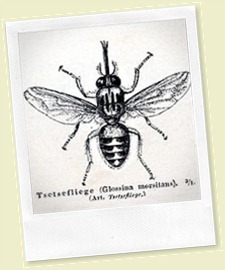
tsetseAfrica is home to a number of indigenous diseases and parasites – schistosomiasis, onchocerciasis (“river blindness”), yellow fever, and trypanosomiasis (“sleeping sickness”). These problems, particularly the tsetse fly, take a toll not only on humans, but on animals as well – severely limiting the availability of beasts of burden. The lack of animal muscle is bad enough in terms of transportation, but one must also consider that where there domestic animals are few in number, natural fertilizer is also missing, reducing the fertility of the land for agriculture.

Of course, at least one disease worked somewhat in Africa’s favor. The threat of Malaria forestalled major colonization by Europeans until the late 19th century when widespread use of quinine offered some protection, helping to end Africa’s reputation as “the white man’s grave” – setting off the “Scramble for Africa”. Historian Clifford Conner wrote, “it was quinine's efficacy that gave colonists fresh opportunities to swarm into the Gold Coast, Nigeria and other parts of west Africa".

Conclusions

Dr. Sowell illustrates just a few of the unique limitations Africa has faced. Many of these problems continue to linger, either in actual fact or at least in the form of the development of the continent being “held back” in the period of 1500-1900.

Saturday, May 5, 2012

Into Africa–Part 1

Apologies for the long hiatus. I’ve been busy with stuff.
I’ve taken quite an interest in Africa over these past many months and feel compelled to share a few blog-sized bits of that.
africa
This excellent graphic, credited to Kai Krause, provides some perspective on the scale of the continent. There’s certainly room for a lot of trouble there.
There are many tragedies in Africa – exploitation, illness, poverty, and hopelessness just to name a few. Perhaps the core tragedy of Africa is the lost opportunity for Africans. The continent is rich in resources of almost every type. Inevitably, this leads one to the central question, namely,“Why is it Africa Always so #%$&@ up then?”
A good friend of mine shared this video with me back in October 2011 and it made a big impression on me. Much of the Bono-driven, well-intentioned aid going on in Africa is little more than paternalistic neo-colonialism. We’re often hurting at least as much as we’re helping.
PovertyCure
I believe that two of Africa’s largest problems are too little freedom and too much socialism. There is an interesting cultural-historic perspective in many African cultures that focuses on group success and helping your neighbors (“It takes a village” etc.). This is not a bad thing per se, but it has been used and twisted by Marxist ideologues over the past 70 years or so to push collectivism. This is not unlike the leftist sloganeering gibbrish in the West of “Jesus was the first socialist”. Clearly there is a difference between my choosing to help and share with my neighbors and a government forcing that “charity”.
In addition to Poverty Cure, there’s also some great work being driven by micro-finance efforts like Unitus.
bookFor a truly interesting perspective, I wholeheartedly recommend The Heart and the Fist by Eric Greitens. Mr. Greitens was an international aid worker with experience in a number of trouble spots – including Africa – when he decided on a career as a Navy SEAL as the best way to truly help these people.
“Eric Greitens is exactly the kind of citizen-warrior that America needs to fight our wars abroad and to win our battles at home. A man wise enough to lead, courageous enough to fight, and compassionate enough to care, he has written a glorious book about how to live with purpose that should be required reading for every American.”
-- Bobby Muller, co-founder of the Nobel Peace Prize-winning International Campaign to Ban Landmines
Stay tuned for more thoughts on Africa!

Monday, November 28, 2011

Carrying the Fire

I wanted to post my initial impressions of my new Amazon Kindle Fire. This isn't meant to be full review, but I did want to capture these while they were fresh and while people were thinking about Christmas gifts.
I've had my Kindle Keyboard with 3G for a little over a year now and I still love it. I have read a lot on it and take it with my often. I also play games (especially Every Word) on it and occasionally browse the web on it - courtesy of the free 3G connectivity. Most of all, I love the fact that I can just charge it about once a month. I mention all of this because these things actually make for a tough act to follow for it's new brother - the Kindle Fire. Maybe it is more of a half-brother, because other than the name they don't really have any relationship at all.
The Fire is a true tablet computer. It has a gorgeous IPS screen - the same type of screen as the iPad in fact. And it can do a lot more than the Kindle reader devices. You can read and edit Microsoft Office documents, you can play Angry Birds or a gazillion other games, you can browse the web in all its glory. And you can consume all sorts of media on it - especially if that media comes from Amazon. It does Facebook, you kids can do your Twittering on it, it does Pintrest, it has a servicable email app (and you can get others from the app market - including those that support Exchange sync, which is lacking in the included mail program).

When I first heard Jeff Bezos announce the Fire, I wasted no time placing my preorder that very morning. It wasn't perfect (more on that in a moment) but it looked like a solid device and seemed to be well integrated into the Amazon family of services. I waited for the release on November 15, scouring the interwebs a couple times a week looking for any scrap of information I could find.
Finally the glorious day arrived and my Kindle Fire arrived at my house - while I was on a cruise to Mexico. :-(One of my older kids was home from college soon after it arrived and I gave her the go ahead to unbox it and play around with it. When I got home I wasted no time in playing with it.
The very next day we headed out for a roadtrip to share
Thanksgiving with family out of state - and the Fire came along.

While it certainly won't win any beauty contests, I am impressed with the device itself. It is solidly constructed and not in the least "plasticy" or cheap feeling. The size and weight feels pretty good in the hand. The battery seems to deliver on the 6-8 hour lifetime Amazon claimed. For the most part, the device is very responsive to touch input, though not as silky smooth as the iPad. The soft keyboard is good and very usable. The automatic screen rotation is a bit too sensitive at times - particularly when the device is held more flat; certainly not unique to the Fire, but a little annoying. I found the speakers and volume really lacking - especially given the media-centric nature of the device. The memory - totaling only about 6GB of available space - has been completely usable so far and I've installed what feels like a lot of stuff without a problem. Obviously, more would be better if you intended to store pictures, music and video on-board. You wouldn't find a 6GB MP3 player very useful. Amazon seems to be relying on their "cloud" for unlimited storage of music, books, and videos you buy from Amazon. All well and good, but it won't help you on an airplane flight.

The biggest failings of the hardware are clearly the lack of even a low res camera and an SD card slot. To be clear, I'm not even looking to use the SD card to boost media storage, but I would like to be able to look at pictures from my camera on a bigger screen and use some kind of cool app to organize them. Another annoyance, though of less importance to me, is the exclusion of a microphone. No microphone and no camera mean no Skype or other web calling and conferencing. Not to mention no snazzy bar code price checking apps, and no Shazam to tell me what song is playing.
On the software side, almost the biggest complaints are the poor performance of the
much touted web browser (my phone is faster over 3G than this browser is over wifi) and the inconsistent availability of common gestures such as zooming in and out.
I know pretty well what this hardware is capable of, and I'm puzzled why Amazon is not using that potential to deliver better performance.

My absolute biggest software complaint, though, is that there is no notion of "users" or "profiles". So when I play Angry Birds, I see that my kid has already unlocked a gazillion levels and I have to remember where I left off. My browser faves are everyone's browser faves. My saved passwords are everyone's saved passwords. I get that this is not my PC, but my Xbox isn't a PC either and it has profiles. I just think this is super lame. (I would say "uber lame", but apparently that is uber lame now.) 

I've seen a lot of haters talking smack about the unique Fire user interface. I actually applaud what Amazon has done here. It is visually interesting and quite functional. I guess I'd call the home screen a "carousel-shelf" sort of effect. The upper part of the screen looks like a bookshelf that permits flicking quickly through your most recently used apps, books, and other media items. In the Fire world, a movie is an app, so is a book, so is a game. I think this matches closely to how people actually think of things. You don't think "I'm going to open the eBook reader and read 'Animal Farm'," you just tap the icon for the book.
Let's face it - the normal Android UI sucks. Kudos to Amazon for bringing their own innovations here. We'll see what people think about it.
Similarly, a lot of internet chatbots have complained that the device is based on Android 2.3 rather than a newer version. Here's the simple fact...none of the target customers of this device care what the OS is. It could be MSDOS 2.3 for all it matters. From most people's perspective, "Amazon" is the operating system.
There are lots of apps in the Fire app store and I had no problems installing and using them. Amazon's "free app of the day" program is very cool. In addition to a few games, I also picked up that aforementioned Documents To Go app, which normally retails for $14.95 and is really quite an impressive MS Office stand-in. The free Netflix app on the Fire is probably the best mobile Netflix experience on any device right now (yup, better than the iPad - but I'm sure they will bring that version up to par soon enough
When I wrote the original draft of this post, I had planned to end it with this ignoble conclusion:
So what am I planning to do next with my Fire? Well, unfortunately, the answer is "return it". The reason is really not related to the device itself. Most of its quirks could be fixed by a software update. The biggest proble is that I have just found nothing that I do on the Fire that I couldn't do as well or better on my ASUS netbook (link). In fact, when I'm traveling, I can connect my netbook to the internet by tethering to my phone. I can't do that on my Fire. Connectivity is the feature I want in a device.
Tablets in general just don't do much.
I was discussing this conclusion with an iPad devoted sister-in-law and she pointed out that her iPad was great for checking Facebook, watching YouTube videos, playing games and checking her email. I agree. But I already have a thing that does all those things in my netbook and does them faster and with fewer limits. She also pointed out that while the iPad keyboard isn't the greatest for writing a lot of text, she has a friend who bought a keyboard case for his iPad - creating in the process the world's most expensive and least capable netbook. :-)
Amazon has an interesting offering in the tablet scene - but it turns out that scene is just too lame.
But an interesting thing happened on the Fire's way back to its box to be sent back...  my wife loves it and has put the kibosh on sending it back. This makes a certain kind of sense. She is also out of the house a lot, but when she is out she is either actually doing something or is with someone. When she's with someone, she is much more curteous about not having her mind elsewhere (or her face in a screen) then, well, me, for example. When she's home, she is well covered by WiFi.
The Fire is an interesting device. It is easily, easily, the best tablet you can buy right now for $199. I say that not just because of the device itself but the whole app and content ecosystem and package of services that stand behind it. I've very interested to see the forthcoming 8.9 and 10 inch successors next year. It has been widely spoken of that this first iteration of the Fire was a stopgap that Amazon chose because the ones they really wanted to sell couldn't be built in quantity in time for Christmas this year. To meet that timeline, they went with an existing design - the Blackberry Playbook. I look forward to the next one.

Friday, April 1, 2011

Are we a nation at war or not?

MourningRibbon

"We are not at war," a veteran who served in the Army for eight years told me Wednesday in Maryland. "Only some of us are."
I wasn't initially sure how to feel about that statement. The painful events of the next 48 hours showed that he was on to something.

So begins today’s post on The Unknown Soldiers, a blog by columnist Tom Sileo. Tom gives a brief bio of six 101st Airborne soldiers killed in Afghanistan on March 30 and asks why we didn’t hear about this on the news. It’s a good question. Seems like a couple years ago we heard lengthy reporting about every US casualty and a constant running count of our total losses in Iraq and Afghanistan – but no more.

For older people who think of war through the prism of Vietnam, it is important to make the point that these are different times. These are not wide-eyed 19 year old draftees, or men who are out of options. These are professional soldiers who could do other things if they chose to do so. These are men who have enlisted or re-enlisted, sometimes several times, since the war in Afghanistan began in the aftermath of 9/11 almost 10 years ago. 

Staff Sgt. Bryan A. Burgess, 29
Pfc. Dustin J. Feldhaus, 20
Sgt. 1st Class Ofren Arrechaga, 28
Staff Sgt. Frank E. Adamski III, 26
Spc. Jameson L. Lindskog, 23
Pvt. Jeremy P. Faulkner, 23

They had parents, wives and girlfriends, some of them had children. Spc Lindskog was a combat medic, a 68-Whiskey (Army MOS 68W), who was caring for his wounded comrades when he was killed. I wonder if we’ll see any politicians or pundits up-in-arms about this violation of the Geneva Conventions? I’m guessing not.

While I don’t know the circumstances of these soldiers, I do know personally many soldiers who have volunteered to go to Afghanistan and Iraq. In my reserve unit, we recently had one of our officers who transferred to another unit just so he could go back and keep doing his job. It’s not bloodlust or crazed desire for the ugliness of war. It’s quiet professionalism and a sense that there is a burden that needs to continue to be carried, even when their friends and neighbors seem to have lost interest. I’m reminded of my own post from October 2010 about Medal of Honor recipient Robert Miller, where I quoted George Orwell speaking of “rough men ready to do violence” on our behalf.

I’ll end with Tom’s closing words from his post:

Are we a nation at war? I still believe the answer is yes. Yet we are also a nation at a crossroads. We cannot think about war only when it's convenient or when someone from our town is killed. To stand by as this pattern develops not only dishonors the brave men and women volunteering to fight, but puts at risk everything they fight for.
To me, being a nation at war means uniting behind our troops and paying attention to their sacrifices. The time for America to do both is now.

Wednesday, March 23, 2011

Fun new multilateralism…now including al Qaida!

In a previous post, I questioned the wisdom of involving ourselves in Libya’s internal civil war.

missilejet

Now that we’ve let dozens of expensive missiles off the chain and lost one of my favorite airplanes (and shot some friendly villagers in the rescue of the pilot), I still think it’s a really bad idea.

In fact, a couple days ago, I coined the “Pulsipher Doctrine” to reduce the decision making process for involvement in military campaigns to simple mathematics. In this case, binary mathematics…

“If France and Italy are strongly in favor of the operation, don’t do it.”

       Pulsipher Doctrine, version 1

truckAs Jay Leno said last night, “Do you notice how shiny all the French planes are? It’s like they’ve never been used before!”

However, after reading press reports today of al Qaida support for the Libyan rebels, I have revised my doctrine:

“If France and Italy, or a worldwide terror network whom you are already fighting in Afghanistan, Pakistan, Iraq, Somalia, Yemen, the Philippines and many other global garden spots, are strongly in favor of the operation, don’t do it.”

      Pulsipher Doctrine, version 2

That’s right folks…this fun new multilateralism is SO expansive and open minded that we’ve found ourselves indirectly allied with our mortal enemy. That can’t be a very good sign.

Kidding aside, let me list a few of the obvious problems with our involvement in Libya:

  • NATO is not the right organization for this. NATO’s charter is to defend member states (Libya isn’t one) against aggression – this is Article 5 of the NATO charter. Article 5 is why NATO was involved in Afghanistan after 9/11 – which is the first time Article 5 was ever invoked.
  • A “No Fly Zone” doesn’t normally involve interdiction of ground operations – a.k.a. blowing up tanks.
  • We don’t know who we are supporting. The same is true in Egypt, Bahrain, Tunisia, etc. Not every conflict involves good guys and bad guys. Sometimes two bad guys fight. Is that the case here? We don’t seem interested in finding out. The British sent a team in to make contact with the rebels in early March, and the rebels captured them and sent them packing in disgrace.
  • Finally, no one in the administration, from the president on down, seems to be able to elaborate on any plan or goals. They can tell us “no ground troops – ever” and “we’re going to quit soon”, but aside from informing Gadhafi of our limits, the rationale is a mystery wrapped in an enigma. If it is about saving oppressed people, there are plenty of those around who are daily being shot at and threatened and we don’t seem as eager to engage in those places.

So after complaining about two wars in Muslim countries – including one “war of choice”, President Obama has now chosen to start a third. What’s more, the “coalition” that Obama has joined (when he wasn’t busy with his NCAA brackets) is half the size of the Bush’s “unilateral” attack on Iraq. As reported, Bush’s coalition consisted of:

Coalition Countries - Iraq - 2003

Afghanistan Albania
Australia Azerbaijan
Bulgaria Colombia
Czech Republic Denmark
El Salvador Eritrea
Estonia Ethiopia
Georgia Hungary
Italy Japan
South Korea Latvia
Lithuania Macedonia
Netherlands Nicaragua
Philippines Poland
Romania Slovakia
Spain Turkey
United Kingdom Uzbekistan

Coalition Countries – Libya – 2011

Belgium

Canada

Denmark France
Germany Greece
Italy Jordan
Morocco Norway
Poland Qatar
Spain United Arab Emirates
United Kingdom al Qaida*

*Italy and Germany were on the list, but have sort of bailed out at this point. Luckily al Qaida has been added to the Libyan coalition based on the new information reported above. And with so few members in the coalition, another participant does help pad the list.

As a side note, just let me say about the Iraq coalition, anytime you can get Ethiopia and Eritrea on the same side of anything, that’s pretty good diplomacy.

Friday, March 11, 2011

Target: Libya

oilrichThe news lately from Libya and hearing the names of important places in the conflict like Ras Lanuf, Sirte, Brega, Benghazi stirred my memory to a past military career - not my current one, my old one. I thought back to 1987 and my memories of anxious hours spent in missions over some of these exact same locations that occupy the news coverage right now.

I dug out one of my old target maps of the AO (Area of Operations) and memories came flooding back.

DSCF0362

DSCF0359Missions start with a target briefing. In this case, you can see the target is the oil terminal at Ras Lanuf – so much discussed of late. Get ready for some $5 gas, people. We all have to sacrifice!


DSCF0365The next step is to select the proper armament for the mission. In this case, I will be taking one stick of Sidewinders – for self-defense against Libya’s still capable air force. I’ve got a couple Mavericks for stand off attacks on patrol boats or surface to air missile sites. For the actual target run, I’ve selected a mix of laser guided GBU-12 bombs and incendiary cluster bombs. How about a little fire there, Scarecrow?  Perfect for attacking an oil facility.

DSCF0369Sitting in the dark, my palms began to sweat. I review the map and mission brief. Then I kick the tires, light the fires and take off into the dark. 
My eyes wander between my various displays and controls and out the cockpit to see the inky blackness of the Gulf of Sirte. An alarm sounds – stealth or no, a patrol boat has a radar lock on me.

DSCF0378It’s already dawn as I approach Ras Lanuf. One of the things I remember about Libya in the 1980s was the startling lack of dimensionality in the structures.

I hit the target, drop down to Angels 2 and book it out of the air defense envelope.

Yes, I remember those many hours sitting in the dark office room of our Japanese apartment flying mission after mission over Libya, Iran and eastern Europe. Good old Microprose Project Stealth Fighter on the Commodore 64. So intense and yet so educational. I feel well prepared to watch the news now.
And I’m very glad that I still have my original C-64 (and several others). I also have my original copy of Project Stealth Fighter that I waited excitedly to be released back in 1987 (along with two other pristine copies I bought in case anything happens to the original).

 DSCF0363

On the other hand, maybe I should have spent more of those nighttime hours with my lonely newly married wife instead.

Friday, March 4, 2011

The new Microsoft “Transform” tablet…

…and I scored one for FREE!!!
You gotta love working at a company where you get great swag like a free tablet just for showing up at an all-hands meeting for the new, reorganized Interactive Entertainment Business (IEB) group.

This new tablet is super portable, lightweight and runs basically forever. These aren’t available publicly yet, but I am giving you a first glimpse right here.

ClosedYou can see here that this new tablet has a very familiar and approachable look. Other than the little Xbox logo in the corner, you could easily mistake this for any traditional pad of paper.

A deeper look shows that the while the familiarity remains, this is a much more sophisticated device.


FamiliarUIBy quickly flipping open the “smart cover”, the tablet is instantly ready for you to use. No long boot up sequence. Notice that it looks like a regular sheet of paper, but with a twist. The Transform tablet “pages” are imprinted with a special SmartGrid that actually helps the user keep their lines straight – both horizontally and vertically. And turning the pages requires just a swipe of a finger – although in this first release you do sometimes need to lick your finger first. That should be fixed in an update to be released soon.


calendar

The ability to manage your calendar and contacts is a must for any serious tablet contender. The Transform tablet doesn’t skimp on in these areas. The calendar shows a full year at a glance and allows you to zoom in on a single month, week or day simply by holding the tablet closer to your face.

contacts

When it comes to contacts, the Transform tablet allows you to store as many as 10(!) friends – which is way more than anyone who works in the software business will ever need.


GamesLike it or not, there’s no disputing the fact that the less sophisticated iPad has shown how important it is to have a lot of fun and engaging multiplayer games available. The Transform tablet not only has great games available right now, but thanks to the Smart Pad multitasking, you can play any number of games at the same time – limited only by how many fit on the page at the same time.

notesGames are not enough though. You need productivity too. Thankfully, the  Transform tablet support rich handwriting and drawing capabilities. You can easily take notes during a meeting and use simple gestures to make quick changes and modifications and save the notes for later use. You can easily add headings, bullets, and add emphasis – simply by using the gestures you already know!

I know what you are wondering…“Will this tablet connect with my the phone I have today?” You’ll be happy to know the answer is a resounding “YES!” You can easily set your phone on top of the pad to prop it up, or you can put the pad on top of the phone to keep dust off your phone. And you can use the phone at the same time as you use the tablet.

I, for one, am SUPER EXCITED about that Microsoft is finally, finally stepping into the tablet game and that they’ve not simply copied what competitors are doing. For example, it was a decision to go beyond just leaving out Cut & Paste (as with Windows Phone 7) but to eliminate electronics entirely – saving weight and improving overall reliability! How else to describe that than BOLD!